
What Goes Into Building a Strong Brand? From Strategy to Identity
Learn what a professional branding process involves, from research and positioning to messaging, visual identity, guidelines and rollout.
Explore BrandingBranding is often reduced to the visible parts:
A logo.
A colour palette.
A typeface.
But those elements are only the expression of a much bigger set of decisions.
A strong brand needs to answer:
- Who are we?
- Who are we trying to reach?
- What do we want to be known for?
- Why should people choose us?
- How should we look?
- How should we sound?
- How should the brand behave consistently across different channels?
That is why a professional branding project usually starts long before logo design.
It begins with understanding the business.
1. Start With the Business
A strong brand needs something meaningful to represent.
Before deciding how a brand should look, understand:
This gives the project context.
A brand designed without understanding the business may look attractive but struggle to communicate anything meaningful.
2. Understand the Audience
Brands are built for people.
That means understanding more than age, location or job title.
Useful questions include:
- What is the customer trying to achieve?
- What problems frustrate them?
- What matters during the buying decision?
- Which alternatives are they considering?
- What gives them confidence?
- What causes hesitation?
This information influences everything from positioning and messaging to visual identity.
3. Understand the Market
A brand does not exist in isolation.
Customers compare it with alternatives.
Competitor research can reveal:
- Common positioning
- Similar messages
- Visual conventions
- Pricing perceptions
- Category expectations
- Opportunities to differentiate
The purpose is not to look different at any cost.
It is to understand which conventions help customers recognise the category and where the brand has an opportunity to own something more distinctive.
4. Define the Positioning
Positioning is the place you want the business to occupy in the customer’s mind.
It should clarify:
- Who the brand is for
- What it offers
- What makes it different
- Why the difference matters
- Why people should believe it
For example, two companies can sell the same type of service but position themselves very differently:
One may compete on accessibility and speed.
Another may compete on specialist expertise and depth.
The service may be similar.
The brand position is not.
5. Clarify the Brand Proposition
The proposition turns strategy into a clear customer-facing idea.
It should communicate the value the business creates without relying on vague phrases such as:
Innovative solutions.
or:
Excellence in everything we do.
A useful proposition makes the value easier to understand.
For example:
Strategic branding for growing businesses that have outgrown how they currently look and communicate.
Specificity usually creates a stronger foundation for messaging.
6. Define the Brand Personality
If positioning explains what the brand means, personality helps define how it behaves.
A brand might be:
- Confident
- Direct
- Warm
- Precise
- Progressive
- Playful
- Understated
These characteristics influence:
The personality should feel appropriate to both the audience and the position.
7. Build the Messaging System
Once the strategic direction is clear, it needs language.
A messaging system might include:
The objective is consistency without making every piece of communication sound identical.
8. Develop the Visual Identity
Now the strategic thinking becomes visible.
A visual identity may include:
A strong identity should do more than look attractive.
It should reinforce the qualities established earlier in the strategy.
If the desired position is premium and considered, the identity should communicate that.
If it is energetic and accessible, the visual system should support a different feeling.
9. Design a System, Not Just a Logo
A logo is one asset.
A brand needs to work across dozens of situations.
Consider:
- Website
- Social media
- Advertising
- Proposals
- Presentations
- Packaging
- Video
- Signage

This is why a strong branding project develops a system.
The identity needs enough structure to remain consistent and enough flexibility to work across different formats.
10. Test the Brand in Real Applications
Before finalising an identity, test it in context.
For example:
| Application | Question to ask |
|---|---|
| Website | Does the brand translate into a useful digital interface? |
| Social | Can it remain recognisable within fast-moving content? |
| Advertising | Can it communicate clearly in a few seconds? |
| Sales material | Does it still feel professional and coherent? |
| Video | Can it move? |
Real applications reveal weaknesses that may not appear when viewing a logo on a blank page.
11. Create Brand Guidelines
Once the system is established, document how it works.
Brand guidelines may include:
- Logo usage
- Colours
- Typography
- Grid and layout
- Photography
- Illustration
- Iconography
- Tone of voice
- Messaging
- Social examples
- Digital examples
The purpose is not to restrict creativity.
It is to make consistency easier.
12. Roll the Brand Out Properly
A rebrand or new identity may touch much more than expected.
Typical rollout items include:
| Area | Typical items |
|---|---|
| Digital | Website / Social / Email / Advertising |
| Sales | Proposals / Presentations / Case studies |
| Content | Photography / Video / Templates |
| Internal | Documents / Training / Brand resources |
| Physical | Packaging / Signage / Printed materials |
A rollout plan prevents the old and new brand from appearing together indefinitely.
13. Protect What’s Worth Keeping
A rebrand does not automatically mean replacing everything.
Existing elements may already have equity.
That could include:
- Name
- Colour
- Logo shape
- Tagline
- Customer recognition
- Search demand
Good brand development looks at what should change and what should remain.
Sometimes evolution is more valuable than reinvention.
14. Brand Strategy and Brand Identity Are Different
These terms often get mixed together.
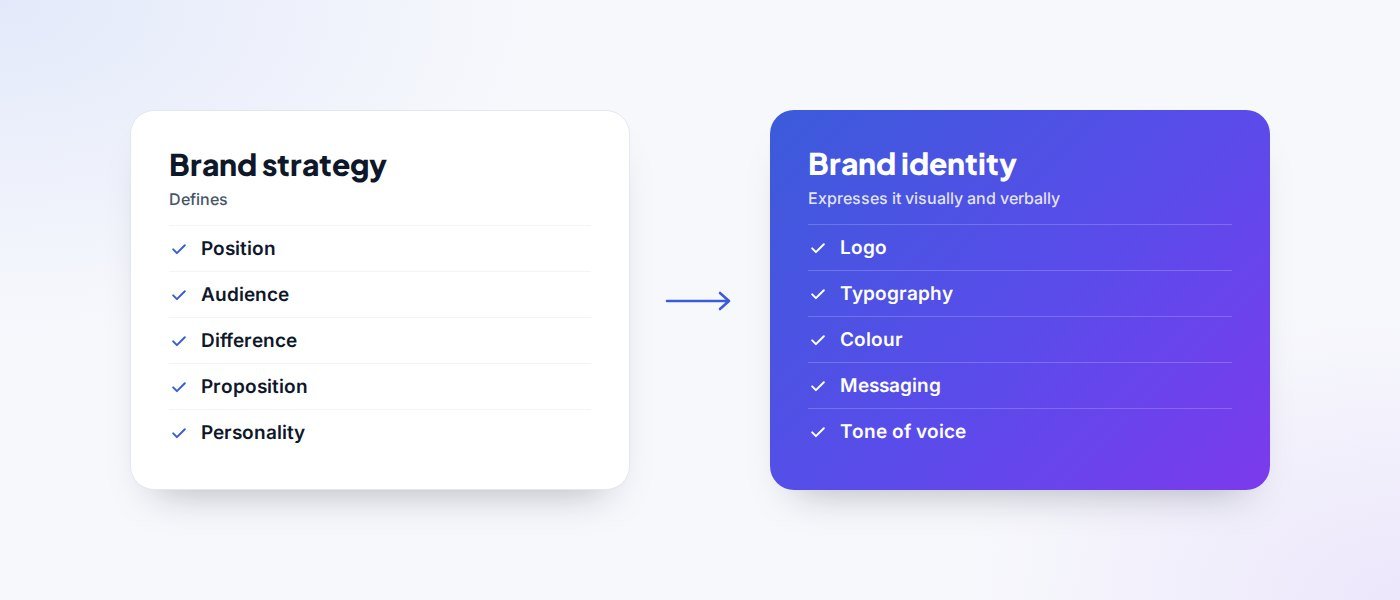
Brand strategy
Defines:
- Position
- Audience
- Difference
- Proposition
- Personality
Brand identity
Expresses those decisions visually and verbally.
Strategy gives the identity direction.
Identity gives the strategy something people can experience.
You usually need both.
15. Branding Does Not End at Launch
A brand becomes stronger through consistent use over time.
That means continuing to:
- Apply it correctly
- Create new content
- Review customer perception
- Evolve templates
- Improve messaging
- Update guidelines
- Adapt to new channels
The launch is the beginning of the brand being used, not the end of the work.
How a Typical Branding Project Might Work
A simplified process could look like:
Every project will differ, but this sequence helps avoid designing an identity before knowing what it is supposed to communicate.
Common Branding Mistakes
| Mistake | Why it matters |
|---|---|
| Starting with the logo | Design has no strategic direction. |
| Following competitors too closely | The brand becomes interchangeable. |
| Trying to appeal to everyone | The messaging loses focus. |
| Choosing everything by personal preference | The brand should serve the audience and business. |
| Building only a visual identity | Messaging and positioning remain unclear. |
| Creating guidelines nobody can use | The system needs to be practical. |
| Treating launch as completion | Brands need ongoing management. |
When Might You Need Professional Branding Support?
It may be worth bringing in a branding partner when:
- You’re launching a new business
- Your company has changed significantly
- Your current identity feels inconsistent
- Customers do not understand your difference
- You’re entering a new market
- You’re moving upmarket
- Your brand no longer represents your quality
- Different teams are communicating differently
- You’re preparing for a major website redesign
The important question is not whether the logo feels old.
It is whether the brand is helping the business move forward.
Conclusion
Strong branding is the result of several connected decisions.
It starts with understanding:
Business → Audience → Market
Then defines:
Positioning → Proposition → Personality
And finally expresses that strategy through:
Messaging → Identity → Applications
When those elements work together, the brand becomes more than a visual style.
It becomes a clearer way for people to understand, recognise and choose the business.