

When Does Your Business Actually Need a Rebrand?
Learn the signs your business may need a rebrand, the difference between a brand refresh and full rebrand, and how to approach the process strategically.
Start a RebrandMost businesses do not need a rebrand simply because the logo feels old.
They need one when the brand no longer represents the business clearly enough.
That can happen because:
A rebrand can solve genuine strategic problems.
But it can also create unnecessary cost, disruption and confusion if there is no clear reason behind it.
That is why the first question should not be:
“Do we need a new logo?”
It should be:
“Is our current brand helping or limiting where the business needs to go next?”
UK government branding guidance similarly starts with business purpose, customer understanding and competitive position before moving into visual identity. (Business Growth Service)
1. What Does a Rebrand Actually Mean?
A rebrand is more than redesigning a logo.
Depending on the business, it may involve changes to:
A visual refresh might change:
- Typography
- Colours
- Photography
- Graphic system
- Logo refinement
A full rebrand goes deeper.
It may redefine:
who the business is, who it is for and what it wants to be known for.
That distinction matters.
Not every outdated-looking brand requires a full strategic rebrand.
2. Rebrand vs Brand Refresh
Before committing to a major project, identify the level of change required.
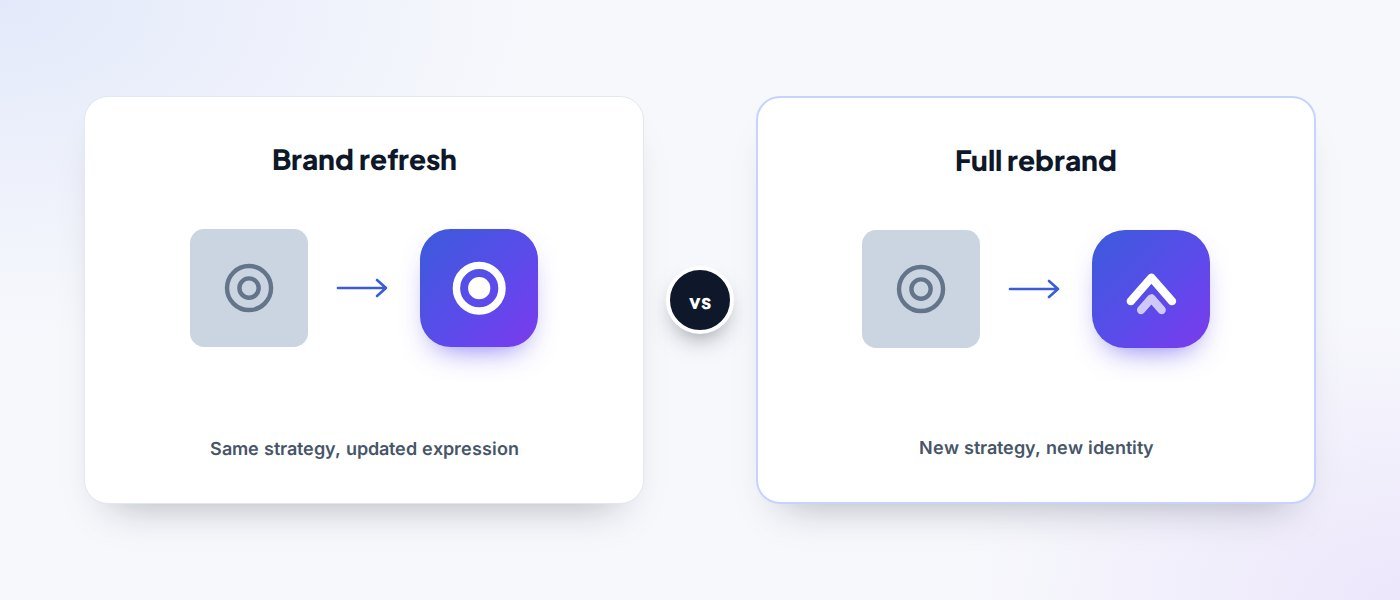
Brand refresh
A refresh improves the existing brand without changing its underlying position significantly.
You might update:
- Logo
- Typography
- Colour palette
- Website design
- Photography
- Templates
This makes sense when the strategy is still sound but the execution feels dated.
Full rebrand
A rebrand is appropriate when more fundamental elements need to change.
For example:
- Your target audience has changed
- Your positioning is unclear
- Your offer has evolved significantly
- Your reputation needs repositioning
- Your name no longer fits
- The business has merged or expanded
The difference is simple:
Refresh the expression when the strategy still works.
Rebrand when the strategy itself needs to change.
3. Sign #1: The Business Has Changed but the Brand Hasn’t
Businesses evolve faster than brands.
You may have started as:
a small local service business
but now operate as:
a national consultancy.
Or perhaps you began with one product and now provide several services.
The problem appears when the brand still communicates the old version of the business.
Typical symptoms include:
- Website copy no longer reflects your offer
- Existing customers understand you, but new prospects do not
- The visual identity feels too small for where the business is now
- Sales teams regularly explain what the company really does
If the gap between what the business is and what the brand communicates becomes too large, a rebrand may be justified.
4. Sign #2: Your Positioning Is No Longer Clear
Good brands make it easy for customers to understand:
- What the company does
- Who it serves
- Why it is different
- Why they should care
If your positioning has become vague, the business may look interchangeable with competitors.
For example:
Innovative solutions for ambitious businesses.
could describe thousands of companies.
A stronger position should be specific enough to create a clear place in the market.
Business.gov.uk recommends examining competitors specifically to understand what makes the business different and where it can fit within the market. (Business Growth Service)
A rebrand can help when the business has a genuine difference but the current brand fails to communicate it.
5. Sign #3: You’re Attracting the Wrong Customers
Sometimes a brand performs exactly as designed — but for an audience the business no longer wants.
Imagine a consultancy originally positioned around affordability.
Over time, it develops:
- More expertise
- Larger clients
- Higher-value services
But the brand still communicates:
cheap, simple and accessible.
That creates a mismatch.
The business wants strategic clients.
The brand keeps attracting price-sensitive enquiries.
A rebrand can help realign:
Audience → Positioning → Messaging → Identity
Business.gov.uk recommends identifying the target customer, their behaviour and the visual and verbal cues that resonate with them before shaping a brand identity. (Business Growth Service)
6. Sign #4: The Brand Looks Similar to Everyone Else
Markets evolve.
A visual identity that once felt distinctive can eventually become generic.
This often happens when an industry converges around the same:
- Colours
- Fonts
- Photography
- Language
- Website structures
Consider technology companies.
If every competitor uses:
- Dark backgrounds
- Blue gradients
- Abstract 3D graphics
- “Transform your business” messaging
then using those same conventions may make the company harder to remember.
Differentiation should not mean being strange for the sake of it.
But if customers cannot distinguish your business from alternatives, that is a brand problem worth investigating.
7. Sign #5: Your Branding Is Inconsistent
Brand inconsistency often appears gradually.
One team creates presentations.
Another designs social posts.
A freelancer updates the website.
Someone else produces proposals.
After several years, the organisation may have:
- Several logo versions
- Different colour palettes
- Different fonts
- Multiple writing styles
- Inconsistent photography
- Conflicting messages
The result feels fragmented.
UK business guidance specifically recommends formal brand guidelines covering visual identity, messaging and how the brand should work across different contexts. (Business Growth Service)
Sometimes the solution is better governance.
But when inconsistency reflects deeper strategic confusion, a rebrand can create a cleaner foundation.
8. Sign #6: Your Brand Is Holding Back Pricing
Brand perception influences perceived value.
Imagine two companies offering similar services.
| One presents itself through: | The other uses: |
|---|---|
| Clear positioning | Outdated visuals |
| Strong case studies | Weak copy |
| Professional design | Generic templates |
| Confident messaging | Inconsistent sales materials |
Even if their technical capability is identical, customers may not perceive them as equal.
If your business has moved upmarket but your brand still signals a lower-value position, it may make higher pricing harder to justify.
A rebrand will not create value by itself.
But it can help the brand communicate value the business already delivers.
9. Sign #7: You’re Entering a New Market
Expansion can change what a brand needs to do.
This might involve:
- Moving from local to national
- Entering international markets
- Moving from B2C to B2B
- Launching enterprise services
- Expanding into a new sector
A name, message or visual style that worked in the original market may not translate well into the next one.
Before changing the brand, research:
- Audience expectations
- Local competitors
- Language
- Cultural meaning
- Existing trade marks
- Domain availability
The brand should be able to travel with the business.
10. Sign #8: You’ve Gone Through a Merger or Acquisition
Mergers create obvious brand questions.
Do you:
- Keep one existing brand?
- Combine both?
- Create a new brand?
- Use an endorsed structure?
- Maintain multiple brands?
The right answer depends on factors such as:
- Brand equity
- Customer recognition
- Market overlap
- Future strategy
- Reputation
A merger is therefore not simply a design exercise.
It is an architecture and positioning decision.
11. Sign #9: The Company Name No Longer Works
Sometimes the issue goes beyond identity.
The name itself may have become limiting.
Examples:
- It describes a service you no longer specialise in
- It ties you to one location
- It is difficult to spell
- It creates confusion with another business
- It does not work internationally
- The domain is problematic
Renaming carries more risk than redesigning a logo because it affects recognition, search behaviour and legal identity.
For UK limited companies, a legal company-name change needs to be registered with Companies House, and certain changes may require shareholder approval. (GOV.UK)
You should also check whether the proposed name conflicts with existing company names or trade marks. GOV.UK notes that names that are identical or sufficiently similar may create problems. (GOV.UK)
12. Sign #10: The Brand No Longer Reflects Your Ambition
Sometimes nothing is technically broken.
But the brand reflects where the business was, not where it is going.
For example:
A three-person startup builds a simple identity quickly.
Five years later it has:
- 60 employees
- International clients
- Multiple services
- A stronger proposition
The original identity may simply have reached the end of its useful life.
That does not make the original branding bad.
It means the business has outgrown it.
13. Reasons NOT to Rebrand
Rebranding can feel exciting.
That does not mean it is necessary.
Avoid rebranding simply because:
| Reason | Why it is not enough |
|---|---|
| The leadership team is bored | Customers may still recognise and value the existing brand. |
| A competitor launched a new identity | Their strategy is not your strategy. |
| You want to fix poor sales quickly | A new brand will not fix a weak offer, product or sales process. |
| You want something “more modern” | Define what business problem modernisation solves. |
| The new CEO prefers another colour | Personal preference is not a strategy. |
A rebrand should solve a real commercial or organisational problem.
14. Start With Research
Do not begin by opening design software.
Begin by understanding the current situation.
Research should include:
This helps distinguish between:
“We don’t like our brand.”
and:
“Our current brand is creating a measurable business problem.”
15. Decide What Should Stay
A rebrand does not mean throwing everything away.
Existing brand assets may have significant value.
That could include:
- Name recognition
- Logo recognition
- Distinctive colours
- Tagline
- Customer trust
- Search demand
- Reputation
The smartest rebrands often preserve useful equity while improving what no longer works.
The goal is:
evolution where possible, reinvention where necessary.
16. Revisit Your Brand Strategy
Before visual work begins, clarify:
Government guidance follows a similar progression: define the business, understand customers and competitors, then develop identity and brand guidelines. (Business Growth Service)
17. Rebuild the Messaging
A rebrand should improve how the business communicates, not only how it looks.
Messaging may include:
- Core proposition
- Tagline
- Elevator pitch
- Service messaging
- Proof points
- Tone of voice
- Website copy
A visual identity can attract attention.
Messaging explains why someone should care.
Both need to support the same position.
18. Develop the New Visual Identity
Only after strategy and messaging are clear should design take over.
The identity may include:
- Logo
- Typography
- Colour
- Photography
- Illustration
- Iconography
- Motion
- Layout
- Digital design system
The objective is not:
“Make it look modern.”
A better brief is:
“Create a visual system that expresses the position we want customers to understand.”
19. Think Beyond the Logo
A new logo shown on a blank page tells you very little.
Test the identity in real situations.
For example:
- Homepage
- Proposal
- Social post
- Video
- App interface
- Advertising
- Packaging
- Signage

The system needs to work across the customer experience.
GOV.UK’s own updated brand guidelines illustrate this principle: its identity was expanded and adapted to work across newer digital channels including its app and wallet rather than being treated as a standalone logo update. (GOV.UK)
20. Create Proper Brand Guidelines
Once the new system is approved, document it.
Guidelines may cover:
Business.gov.uk recommends formalising both personality and visual identity in brand guidelines so the brand remains consistent after launch. (Business Growth Service)
A rebrand without implementation rules can quickly become inconsistent again.
21. Protect the New Identity
If you introduce a new:
- Name
- Logo
- Product brand
consider intellectual-property implications.
Current UK Intellectual Property Office guidance notes that registered IP, including trade marks, can help businesses protect recognition and reputation and can contribute to business value. (GOV.UK)
Depending on the project, this may involve:
- Trade-mark searches
- Registration
- Domains
- Social handles
Seek specialist legal advice where appropriate.
22. Plan the Rollout
A rebrand touches more places than most businesses expect.
Create an inventory.
| Area | What to update |
|---|---|
| Digital | Website · Social accounts · Email signatures · Advertising · Apps · CRM emails |
| Sales | Proposals · Presentations · Brochures · Case studies |
| Internal | Templates · Documents · Training · Policies |
| Physical | Signage · Packaging · Uniform · Vehicles · Offices |
Without a rollout plan, customers can see the old and new brand simultaneously for months.
23. Don’t Forget SEO During a Rename or Website Change
A rebrand can affect organic search if it includes:
- Domain change
- URL changes
- New site structure
- Company name change
Protect existing visibility carefully.
Important considerations include:
Do not treat SEO as something to fix after the new site launches.
It should be part of the migration plan.
24. Tell People Why the Brand Changed
You do not necessarily need a dramatic:
“BIG NEWS. WE REBRANDED.”
campaign.
But customers and employees should understand what changed and why.
Useful communication might explain:
- How the business has evolved
- What has changed
- What remains the same
- What customers can expect
This is particularly important if the name changes.
Clarity reduces confusion.
25. Bring the Team With You
Employees use the brand every day.
If they do not understand the new:
- Positioning
- Messaging
- Tone of voice
- Visual system
the rebrand will fragment quickly.
Internal rollout may include:
- Brand presentation
- Guidelines
- Templates
- Training
- FAQs
- Launch resources
The brand needs internal adoption before it can achieve external consistency.
26. How Long Does a Rebrand Take?
There is no universal timeline.
A small brand refresh may take weeks.
A major rebrand involving:
- Research
- Positioning
- Naming
- Identity
- Website
- Multiple markets
- Complex rollout
may take several months.
The biggest variable is usually not logo design.
It is the scale of the strategic and implementation work.
27. What Does a Rebrand Cost?
Again, there is no useful universal figure.
Cost depends on:
A better question than:
“How much does a rebrand cost?”
is:
“What needs to change for this rebrand to achieve its business objective?”
Then scope the work around that.
28. How Do You Measure Whether a Rebrand Worked?
Rebranding should be measurable where possible.
Potential indicators include:
| Indicator | What to ask |
|---|---|
| Brand awareness | Are more relevant people recognising the business? |
| Branded search | Are more people searching specifically for the brand? |
| Conversion | Has clearer positioning improved response? |
| Lead quality | Are you attracting more appropriate customers? |
| Pricing perception | Does the business support the value it wants to communicate? |
| Employee clarity | Can staff articulate the brand consistently? |
| Customer research | Do customers understand the intended position? |
Not every benefit appears immediately.
But the rebrand should have defined objectives before it begins.
Rebranding Checklist
A rebrand may be worth exploring if:
- The business has changed significantly
- Your positioning is unclear
- You’re attracting the wrong audience
- You look interchangeable with competitors
- The identity is inconsistent
- The brand no longer reflects your pricing
- You’re entering new markets
- You’ve merged with another company
- Your name has become limiting
- The brand no longer reflects where the business is going
If only the visual style feels slightly dated, a brand refresh may be enough.
Conclusion
A rebrand should not begin with a new logo.
It should begin with a reason.
The strongest rebrands happen when there is a clear gap between:
the business you are today
and:
the brand customers currently see.
Start by understanding:
- The business
- The audience
- The market
- The current brand
- The future ambition
Then decide how much needs to change.
Sometimes the answer will be a full strategic rebrand.
Sometimes it will be a smaller refresh.
And sometimes the smartest decision is to keep the existing brand and improve how it is used.
The goal is not simply to look new.
It is to create a brand that represents the business more clearly and gives it room to move forward.