

Google Ads vs Meta Ads: which is right for your business?
Compare Google Ads and Meta Ads for intent, targeting, creative, costs, lead generation and ecommerce to decide which platform fits your business.
Plan Your Paid CampaignOne of the most common questions businesses ask before investing in paid advertising is:
Should we spend our budget on Google Ads or Meta Ads?
It sounds like a simple choice.
But the two platforms often play very different roles.
Google Ads can place your business in front of people who are actively searching for a product, service or solution. Google explains that Search ads can appear based on how closely a person’s search matches an advertiser’s keywords and campaign settings. (Google Help)
Meta Ads work differently. Facebook and Instagram advertising can reach people while they are consuming content, using creative, audience signals and campaign objectives to generate awareness, consideration and action. Meta also supports formats such as Reels, designed around mobile-first discovery and engagement. (Facebook)
So the better question is not:
Which platform is better?
It is:
Which platform is better suited to the customer journey, objective and buying behaviour of your business?
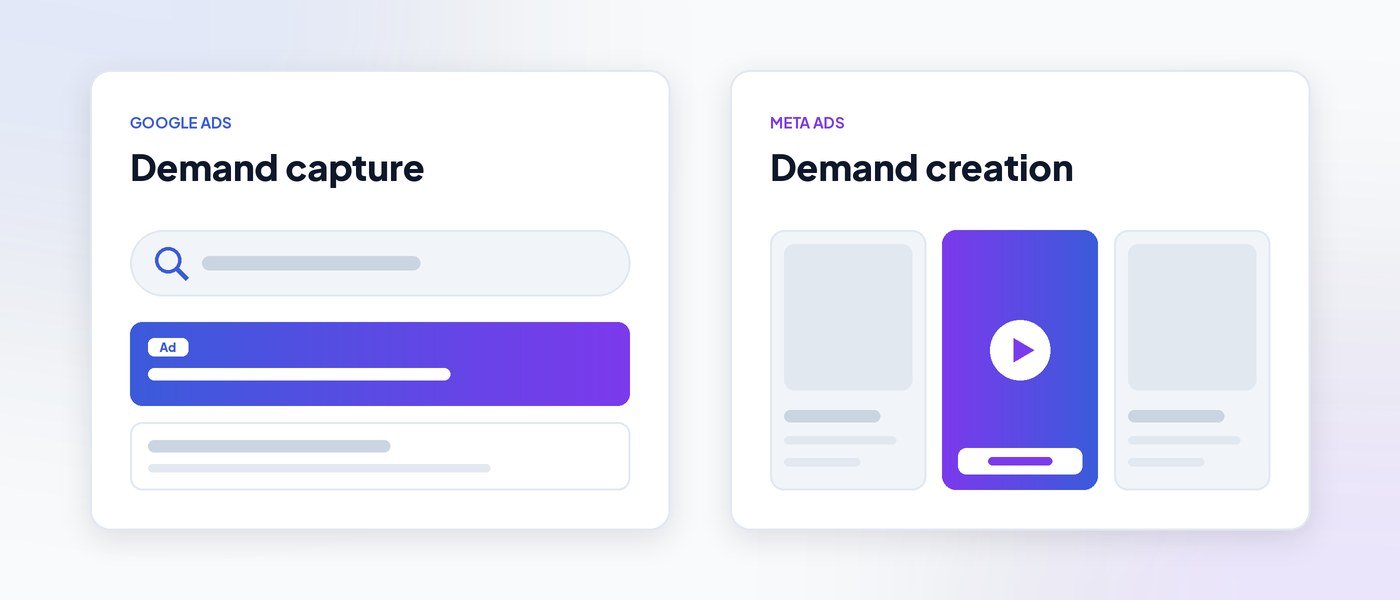
1. The biggest difference: demand capture vs demand creation
This is the most useful way to understand the two platforms.
Google Ads often captures existing demand
Someone searches:
- emergency plumber London
- accountant for contractors
- buy running shoes online
- CRM software for small business
The person already has a need.
Your job is to appear at the right moment with a relevant offer.
Google Ads can therefore be especially effective when people already search for your product or service.
Meta Ads can help create or stimulate demand
Someone scrolling Instagram may not currently be searching for:
ergonomic office chair
or:
brand strategy agency
But the right creative may introduce a problem, product or idea that earns their attention.
This is where Meta can be powerful.
It can help businesses:
- Build awareness
- Introduce products
- Generate interest
- Retarget previous visitors
- Promote offers
- Drive leads
- Generate ecommerce sales

The distinction is not absolute — both platforms can support multiple stages of the funnel — but search intent is usually much stronger on Google Search.
2. Google Ads: where it tends to work best
Google Ads can be particularly strong when customers already know what they need.
Examples include:
If people are actively looking for the thing you sell, Google Ads gives you the opportunity to meet that demand.
3. Meta Ads: where it tends to work best
Meta can be especially useful when strong creative can generate interest before someone begins actively searching.
Examples include:
Meta’s Reels advertising guidance emphasises mobile-first video creative, placement strategy and testing as important components of campaign performance. (Facebook)
4. How customer intent differs
Imagine two potential customers.
Customer A
Searches:
“best payroll software UK”
That person is demonstrating clear intent.
Google Ads can place a relevant solution directly in front of them.
Customer B
Is scrolling Instagram and sees a short video explaining:
“Three payroll mistakes costing small businesses hours every month.”
They may not have been actively searching, but the ad creates awareness of a problem.
Meta may then introduce the solution earlier in the buying journey.
Both are valuable.
They simply reach people in different contexts.
5. Google Ads usually requires strong keyword strategy
Search campaigns rely heavily on understanding how customers search.
That means researching:
The goal is not simply to buy more clicks.
It is to buy relevant clicks.
A campaign generating 1,000 low-quality visitors may be far less valuable than 100 visitors with strong purchase intent.
6. Meta Ads usually requires stronger creative
On Google Search, someone has already expressed interest through their query.
On Meta, your advertisement often needs to earn the attention first.
Creative therefore becomes critical.
Strong Meta advertising may require:
- Video
- Reels
- Product imagery
- Testimonials
- UGC-style content
- Strong hooks
- Clear offers
- Multiple creative variations
Meta encourages advertisers to test creative and adapt formats for placements such as Reels; its own guidance highlights vertical video, safe-zone placement and experimentation. (Facebook)
This means the success of a Meta campaign is often connected closely to the quality and quantity of creative available.
7. Which platform is better for lead generation?
Both can generate leads.
But the nature of those leads may differ.
Google Ads
A person searches:
business accountant near me
and submits an enquiry.
The intent is explicit.
Meta Ads
A person sees:
Free tax planning consultation for growing businesses
and submits a lead form.
The advertisement created the opportunity.
Neither approach is automatically superior.
The right choice depends on:
8. Which is better for ecommerce?
Again, the answer can be both.
Google can capture product demand
For example:
men’s waterproof hiking boots
Someone searching this may already be close to buying.
Meta can create product discovery
A customer sees a compelling product video while scrolling Instagram.
They were not searching for the product, but the creative generates interest.
For many ecommerce brands, the strongest strategy is not:
Google or Meta
but:
Google and Meta performing different jobs.
9. Retargeting changes the picture
Most people do not convert the first time they encounter a business.
This is where retargeting becomes valuable.
A typical journey might look like:
Paid channels often work together rather than independently.
10. Your website still matters
Advertising cannot compensate indefinitely for a poor landing experience.
If your ads generate clicks but your website has:
- Slow loading times
- Weak messaging
- Poor mobile UX
- No social proof
- Complicated forms
- Unclear pricing
- Weak CTAs
then you may simply pay to send more people into a poor experience.
Before significantly increasing ad spend, make sure your website is capable of turning traffic into action.
This creates an important relationship:
Advertising → Landing page → Conversion
not simply:
Advertising → Clicks
11. Conversion tracking is essential
Neither Google nor Meta should be managed purely around clicks.
You need to know what happens after someone interacts with an ad.
Google Ads allows businesses to define conversions such as purchases, sign-ups, calls or other valuable actions. Google states that conversion measurement helps advertisers understand which keywords, ads and campaigns are generating meaningful customer activity. (Google Help)
Google’s conversion tools can also measure different actions separately, including website activity, phone calls and app activity. (Google Help)
Without reliable tracking, campaign optimisation becomes guesswork.
12. Don’t choose a platform based on CPC alone
Businesses often compare:
Google costs £X per click.
Meta costs £Y per click.
This can be misleading.
A £10 click that generates a profitable customer may be far more valuable than a £1 click that generates nothing.
Instead, evaluate metrics such as:
Cheap traffic is not necessarily effective traffic.
13. Think about the sales cycle
The longer the sales cycle, the more important multiple touchpoints become.
Consider a £30 product.
The customer might see it, like it and purchase immediately.
Now consider a £30,000 business software platform.
The buyer may:
- Read articles
- Search Google
- Visit the website
- Watch a webinar
- See social advertising
- Compare competitors
- Speak with sales
Attributing that entire sale to one advertisement can oversimplify what actually happened.
14. Google Ads vs Meta Ads by objective
| Business objective | Google Ads | Meta Ads |
|---|---|---|
| Capture active search demand | Strong | Limited |
| Build awareness | Good | Strong |
| Product discovery | Good | Strong |
| Local service enquiries | Strong | Good |
| Visual ecommerce products | Strong | Strong |
| Retargeting | Strong | Strong |
| B2B high-intent search | Strong | Useful supporting channel |
| Video-led campaigns | YouTube/Display | Strong social environment |
| Immediate problem solving | Strong | Depends on offer |
This is not a universal scorecard.
Performance depends heavily on the business, creative, offer, audience and implementation.
15. Which should a small business start with?
Ask these questions.
16. When Google Ads and Meta Ads work together
The strongest paid-media strategy may involve both.
For example:
- Google
Capture people already searching. - Meta
Introduce the brand to new audiences. - Google
Capture branded searches created by awareness. - Meta
Retarget website visitors. - Google and Meta
Continue reaching prospects across the buying journey.
This creates a connected paid-media system rather than two isolated advertising accounts.
17. Common Google Ads mistakes
| Mistake | What to remember |
|---|---|
| Sending all traffic to the homepage | Use landing pages aligned with the search intent. |
| Targeting overly broad keywords | More traffic does not automatically mean better results. |
| Ignoring negative keywords | Irrelevant queries can waste budget. |
| Poor conversion tracking | You cannot optimise effectively if you don’t know which actions matter. |
| Measuring clicks instead of business outcomes | Focus on leads, sales and revenue. |
18. Common Meta Ads mistakes
| Mistake | What to remember |
|---|---|
| Using the same creative for months | Creative fatigue can reduce effectiveness. |
| Designing ads like traditional corporate graphics | Social platforms reward content that fits naturally into the environment. |
| Weak opening hooks | You have little time to earn attention. |
| Targeting without strong messaging | Audience targeting cannot fix an irrelevant offer. |
| Ignoring landing-page quality | Strong creative still needs somewhere effective to send the customer. |
19. Privacy and consent matter
Advertising measurement involves customer and website data, so businesses need appropriate privacy and consent processes.
Google states that advertisers should clearly explain the data they collect and obtain consent where required by law and relevant Google policies. (Google Help)
Meta’s customer-list audience terms similarly require advertisers using customer data to have the appropriate rights, permissions and lawful basis for that data. (Facebook)
For UK businesses, this means advertising implementation should be considered alongside your wider privacy and consent setup.
20. So which platform should you choose?
Choose Google Ads first when:
- Customers actively search for what you offer
- Intent is high
- Search volumes exist
- The problem is already understood
- Lead generation is the main objective
Choose Meta Ads first when:
- Discovery matters
- Your offering is visual
- Strong creative is available
- You need to create demand
- Social proof and storytelling influence decisions
Consider both when:
- Your buying journey involves several touchpoints
- You want to capture existing demand while creating new demand
- Retargeting is valuable
- Budget is sufficient to test both properly
Conclusion
Google Ads and Meta Ads are not really competitors in the way many businesses assume.
They often solve different parts of the same marketing problem.
Google can help you appear when someone is actively looking.
Meta can help you become the business they later look for.
The strongest strategy starts with the customer journey rather than the advertising platform.
Understand:
- How customers discover the problem
- Where they research solutions
- What influences their decision
- What action you want them to take
- How you will measure success
Then choose the channel — or combination of channels — that fits that journey.