

How much does a website cost in the UK in 2026?
A practical guide to website costs in the UK, what influences pricing, common hidden costs and how to choose the right investment for your business.
Start a ProjectIntroduction
One of the first questions businesses ask before starting a website project is:
How much should a website actually cost?
The answer varies widely. A simple brochure website requires a very different level of investment compared with an ecommerce platform, a lead-generation website or a custom web application.
In this guide, we’ll explore the factors that influence website costs in the UK and how to budget for a project with confidence.

Why website costs vary so much
A website isn’t a single product. Two websites may look similar on the surface but require completely different levels of planning, design, development and ongoing support.
The biggest cost factors typically include:
Recent UK pricing analyses consistently identify custom functionality, content creation, SEO foundations and long-term support as major drivers of project cost (source: Built Proper).
Typical investment levels
You’ll find prices ranging from a few hundred pounds to tens of thousands of pounds. As a guide, this is where most professionally built projects sit:
| Website type | Typical investment (UK) |
|---|---|
| Brochure website | £3,000 – £8,000 |
| Lead generation website | £6,000 – £15,000 |
| Ecommerce website | £8,000 – £25,000 |
| Custom web application | From £20,000 |
These are guide ranges, not quotes: scope, content and functionality move a project up or down. For context, published UK guides put professional agency builds at roughly £1,500 to £10,000+ and complex platforms and web apps at £20,000+ (HDC Consultancy).
Common website types and typical investment levels
Different businesses have different goals. Here’s an overview of the most common website types and what they typically include.
Brochure Websites
Ideal for local businesses, professional services and small companies looking to establish a credible online presence.
Typical features:
- Home page, about, services, contact
- Basic SEO setup
- Mobile responsive design
Typical investment (UK)
£3,000 – £8,000
Lead Generation
Ideal for B2B businesses, service companies, agencies and professional firms that need a steady flow of qualified enquiries.
Typical features:
- Conversion-focused UX and landing pages
- CRM integrations, tracking and analytics
- SEO architecture
Typical investment (UK)
£6,000 – £15,000
Ecommerce
Ideal for retail businesses and direct-to-consumer brands that want to generate online sales.
Typical features:
- Product management and payment processing
- Shipping integrations and inventory systems
- Customer accounts
Typical investment (UK)
£8,000 – £25,000
Custom Applications
Ideal for SaaS businesses, membership platforms and internal business systems that support operations or deliver digital products.
Typical features:
- User authentication and custom workflows
- Database architecture
- API integrations
Typical investment (UK)
From £20,000
The hidden costs many businesses overlook
One of the biggest mistakes businesses make is focusing solely on the launch cost. A website is an ongoing business asset.
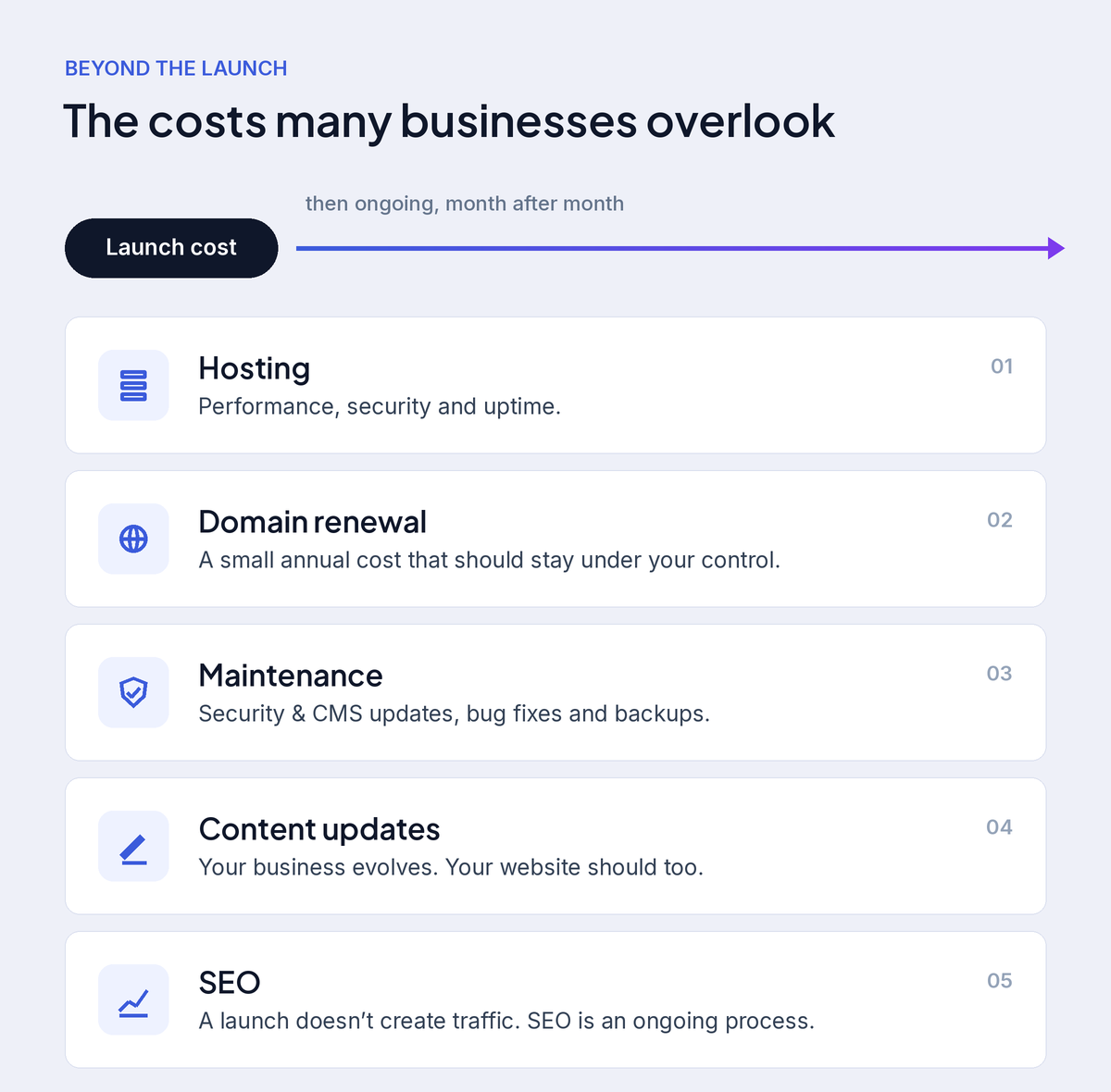
Potential ongoing costs include:
Hosting
Reliable hosting helps maintain performance, security and uptime.
Domain renewal
A relatively small annual cost that should always remain under your control.
Maintenance
Includes security updates, CMS updates, bug fixes and backups.
Content updates
Businesses evolve. Websites should evolve too.
SEO
A website launch does not automatically generate traffic. SEO is an ongoing process.
Many UK pricing guides stress that hosting, maintenance, SEO and content updates are often omitted from headline build costs despite being essential long-term considerations (source: HDC Consultancy).
What actually creates ROI?
The cheapest website is rarely the most affordable. A website should:
- Generate enquiries
- Support sales
- Build trust
- Improve visibility
- Reduce friction for customers
A website that produces leads consistently can create value far beyond its initial cost. The focus should be on outcomes rather than the lowest quote.
Questions to ask before choosing a website partner
Before comparing proposals, ask:
- Do they understand our business goals?
- Will the website be custom or template-based?
- Is SEO considered from the beginning?
- Who creates the content?
- What happens after launch?
- Will we own the website?
- How is performance measured?
These questions often reveal more than the price itself.
Choosing the right investment level
The right website investment depends on:
- Business goals
- Market competition
- Growth plans
- Customer journey complexity
- Required functionality
Rather than asking “What’s the cheapest option?”, ask:
What does our business need to achieve online?
That question usually leads to better decisions.
Conclusion
Website costs vary because businesses have different goals. A simple website may be enough for some organisations. Others require advanced functionality, stronger conversion optimisation and a more strategic digital presence.
The best investment is the one aligned with your business objectives and future growth plans.